
What You Pay Attention to Grows: A Psychologist's Guide to Mental Bandwidth and Being More Present

Hi friends,
Hopefully by the time you see this, we are officially in summer!
After another long Midwest winter, I notice myself appreciating the return of migrating birds, my daffodils coming up, and the way the light feels warmer even on colder days.
Today I wanted to share some reflections I’ve been having on the power of attention. There's a principle that runs through pretty much every wisdom tradition and now in psychological research that what we attend to grows. Our attention is one of the most precious resources we have, and it is not neutral. The news cycle, our phones, the ten different worries that pop up at 2am, the conversations we slow down to be present in, the breath we notice between yoga poses ~ all of it contributes to our energy and our mindset.
Attention Is a Limited Resource
From a behavioral economics perspective there is a concept that attention is genuinely scarce. Not just in a "we're all so busy" hand-wavy way, but in a measurable cognitive way. When our attention is consumed by financial worry, time pressure, or the chronic low-grade pull of our phones, we have less mental bandwidth for everything else.
Let’s direct our mental bandwidth to what’s important to us:
being present with children
doing our work well
growing the values we care about in the world
I would like to encourage us to notice where our attention goes and think of it as a currency.
Toward, Not Away
So much of anxiety is attention to perceived threat: what I'm afraid of, what could go wrong, what I'm trying to avoid. We want to flip the question. Instead of asking what don’t I want today? We ask what matters to me, and what's one small step toward it?
This is not about toxic positivity or pretending hard things aren't hard. It's about deciding deliberately where to direct the limited resource of your attention.
(Related reading: Building the Skill of Tolerating Uncertainty)
Attentional Experiments
As you probably know by now, I’m all about behavioral experiments, so I’ve been playing with some attentional experiences in my own life. Like:
Putting my phone in another room when I’m watching a show or reading a book. I find that even having my phone in my visual space contributes to the pull to quickly look something up or respond to that text from a few days ago that I forgot about until now, which pulls me out of the activity I am doing, making it feel less relaxing.
Deliberate mono-tasking (the opposite of multitasking). For example closing out my email while working on this newsletter. (Truth - I’m going to have to put my phone in the other room because I keep getting notifications!). Or when was the last time you went to a webinar or zoom meeting without simultaneously trying to catch up on email (gulp! me too!)?
Talking with/listening to family without unloading the dishwasher, cooking, attempting to finish chores (same idea as above).
In our current culture we are trained that multitasking and efficiency are optimal, but we want to be aware of how this constantly divided attention can diminish or alter our experience. It’s 100% ok to multitask and we all need to do it, but can we make it a choice versus a default?
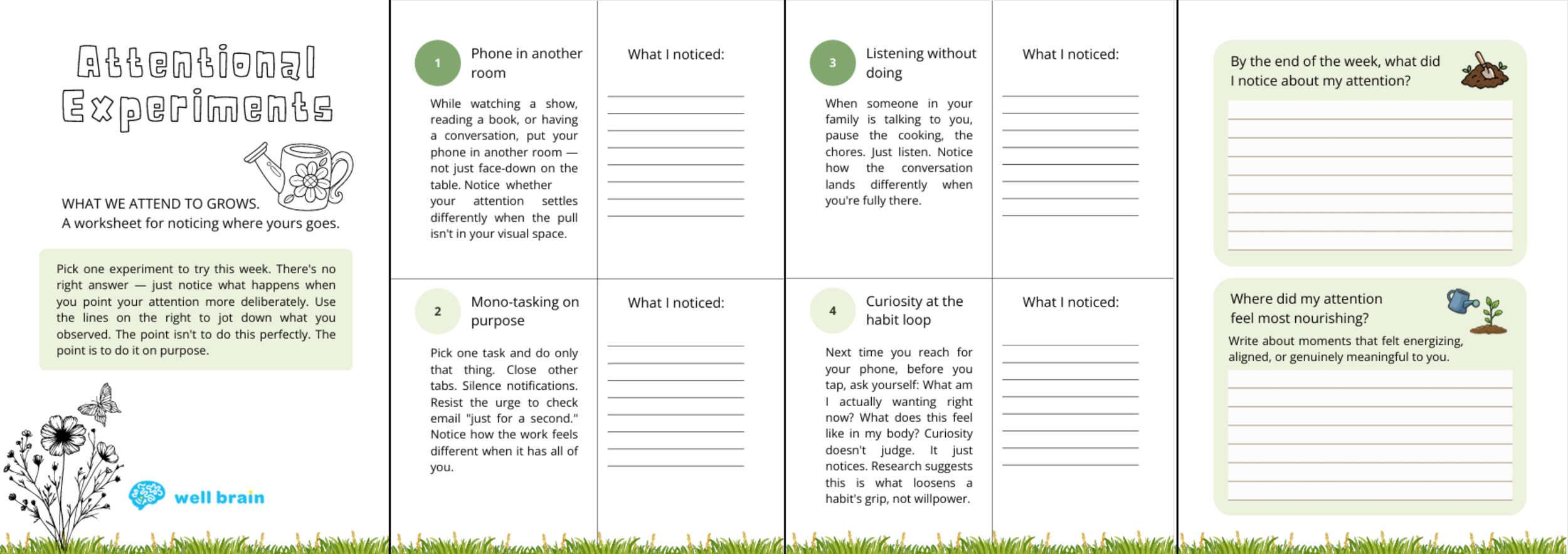
If you'd like to explore your own habits around attention, mindfulness, distraction, and presence, you can download the worksheet below.
Reminders for Parents
You’ve probably heard me say “any attention is ‘good’ attention” if we’ve had a parent session. Kids crave attention and any behavior that gets attention (even if that attention is yelling/negotiating, etc) makes the behavior more likely to repeat. It’s not common sense. Instead of “don’t hit your brother” we have to be intentional with our attention and catch them being good “I like the way you are sharing and using gentle hands!”
The first example teaches kids that if I want mom or dad to tune in, I get their attention by hitting my brother. The second teaches that sharing and gentleness gets positive reinforcement. (None of us are perfect and modern parents are maxed out, so I say this all with compassion!).
What Will You Grow?
Your attention is, in a very real way, a form of love. It's also a form of power. Where you point it, things grow. So, what will you grow this season?
We're here to help if you'd like support paying more deliberate attention to what matters,
Dr. Rachel and the Well Brain Team
P.S. A reminder that transitioning to summer is still a transition! I wrote about it in a previous article.